"Las lenguas no son fronteras que separan, sino puentes que unen"
Tuesday, 11 February 2014
Monday, 10 February 2014
Valentine's Day: What's in a Heart?
Valentine Day is coming! For some cultures, it’s a day of romance, of hearts and flowers. For others, it’s a Day of Friendship. The day is Saint Valentine’s feast, and many cards and flowers will be exchanged (as well as chocolates and other gifts).
The day has several symbols. One of the most popular is the heart, which represents love and caring. The heart is used in any number of expressions. Below is a list. See if you can think of why “heart” is used to describe these ideas.
1. “She has a heart of gold” means that she to cares about other people.
2. “He has a big heart” means the he is a giving, generous person.
3. “She is cold-hearted” means that she doesn’t feel sympathy for other people.
4. “He wears his heart on his sleeve” means he shows everybody how he feels about someone (or something).
5. “Cross your heart and hope to die” means that you swear something is true or that you promise to do something.
6. “She cried her heart out” means that she cried a lot because she felt really
badly about something.
7. “They are eating their hearts out” means deep sadness about something.
8. “Eat your heart out!” is a sarcastic expression meaning “Too bad you can’t [be someone][do something].”
9. “I sympathize from the bottom of my heart” means that I feel really deep sympathy.
10. “He had a change of heart” means that he changed his opinion or his mind about something.
11. “Have a heart!” means “Be compassionate, be understanding.”
12. “My heart was in my mouth!” means I was very nervous or I was scared.
13. “Try to set your heart at rest” means to try to relax or stop worrying.
14. “She’s really soft-hearted” means she’s sympathetic or compassionate
15. “He really took the Broncos’ loss to heart” means he was very disappointed by the loss.
16. “She’s learned the poem by heart” means she has the poem in her memory.
17. “He is a football fan, heart and soul!” means he’s a very enthusiastic fan of football.
18. “In her heart of hearts, she doesn’t believe that” means in her most private thoughts, she doesn’t believe something.
19. “He lost his heart to Mary” means he fell in love with Mary.
20. “She has her heart set on going to China” means she really really hopes to go to China.

The day has several symbols. One of the most popular is the heart, which represents love and caring. The heart is used in any number of expressions. Below is a list. See if you can think of why “heart” is used to describe these ideas.
1. “She has a heart of gold” means that she to cares about other people.
2. “He has a big heart” means the he is a giving, generous person.
3. “She is cold-hearted” means that she doesn’t feel sympathy for other people.
5. “Cross your heart and hope to die” means that you swear something is true or that you promise to do something.
6. “She cried her heart out” means that she cried a lot because she felt really
badly about something.
7. “They are eating their hearts out” means deep sadness about something.
8. “Eat your heart out!” is a sarcastic expression meaning “Too bad you can’t [be someone][do something].”
9. “I sympathize from the bottom of my heart” means that I feel really deep sympathy.
10. “He had a change of heart” means that he changed his opinion or his mind about something.
11. “Have a heart!” means “Be compassionate, be understanding.”
12. “My heart was in my mouth!” means I was very nervous or I was scared.
13. “Try to set your heart at rest” means to try to relax or stop worrying.
14. “She’s really soft-hearted” means she’s sympathetic or compassionate
15. “He really took the Broncos’ loss to heart” means he was very disappointed by the loss.
16. “She’s learned the poem by heart” means she has the poem in her memory.
17. “He is a football fan, heart and soul!” means he’s a very enthusiastic fan of football.
18. “In her heart of hearts, she doesn’t believe that” means in her most private thoughts, she doesn’t believe something.
19. “He lost his heart to Mary” means he fell in love with Mary.
20. “She has her heart set on going to China” means she really really hopes to go to China.

Monday, 3 February 2014
Pete Seeger: A Song-Full Life
Pete Seeger died on January 27, 2014. You may not have heard of him, but you’ve heard his work. A classic Spanish language version of “If I Had a Hammer” adapted and translated to Spanish by Victor Jara is still played (you can find it here: http://www.youtube.com/watch?v=vlKq0KmQRz4&list=PLB1D57B284E88AF12).
Pete Seeger was basically a simple man. His parents let him introduce himself to music. They left different kinds of instruments around his house for him to play with. He chose “fretted stringed instruments,” as he described them in an interview. He started playing and collecting folk songs in the 1930s. His life's work focused on local, historical musical influences and showing how folk music expresses culture. He played 12-string guitar. He also was master of the 5-string banjo and literally wrote the book on how to play it. He saw the music as important for itself, but as a potent tool for political activism, as well; he said once said he'd like to be remembered as someone who “made up songs to try and persuade people to do something,” not just say something.
One song he collected and adapted was “We Shall Overcome.” (you can hear him sing it and see the words at http://www.youtube.com/watch?v=QhnPVP23rzo&list=RDD2h_ETDoTys). It was the anthem of the U.S. Civil Rights movement in the 1960s. It has been used to express non-violent protest against war and oppression throughout the world.
“Where Have All the Flowers Gone” was inspired by a song quoted in the novel And Quiet Flows the Don by Mikhail Sholokhov. Two more verses were added by Joe Hickerson in 1960, resulting in the peace song known in more than 20 languages today. This song is an example of what Seeger thought songs should do: grow and change with the conditions that surround them. (You can hear a version here: http://www.youtube.com/watch?v=IvC9sbK725M)
Seeger influenced many younger singers and with Woody Guthrie can be said to have started the folk music revival of the 60s and 70s in the US. Bob Dylan and Joan Baez were among the young singer-songwriters he influenced in the 60s, but he continued to inspire singer-songwriters throughout his life. He believed in music as a unifying force that can change the world person by person. On his 5-string banjo, he wrote the words: “This Machine Surrounds Hate and Forces it to Surrender.”
Yet his most lasting legacy may be a river.
In the 1960s, Seeger co-founded Hudson River Sloop Clearwater, Inc. A sloop is the sailing vessel that once carried goods and passengers on the Hudson River that flows between New York and New Jersey. The Hudson River in the 60s was so polluted it was said that Caribbean ships would sail into its waters so the poisons could kill the bore worms in their wooden hulls. Seeger set out to clean the river up. Everyone said it couldn't be done.
A new sloop, the Clearwater, was built with money raised by volunteers and through benefit concerts. She was launched in South Bristol, Maine in 1969 and sailed to the South Street Seaport Museum in New York City. Then she started to travel the Hudson.
She still sails the river, after more than 40 years. The Hudson is much improved, thanks in large part to the help of the organization Pete Seeger helped found and supported. You can now swim in water once so poisonous it could clean ship hulls of parasites. The Clearwater carries volunteer and professional crew members; her main job is to teach school kids about the river's ecology.
Pete Seeger was a simple man. Ten days before his death, he was still chopping wood outside the modest home he and his wife had built in upstate New York. His wife, Toshi, died last year; they were married almost 70 years. On their 69th wedding anniversary, Pete Seeger took a couple of hours to go to a protest meeting and lead neighbors in singing a song or two. It wasn’t a big deal. He believed you had to stand with your neighbors when they needed you, so he went.
Bob Dylan once said of Pete Seeger, “He had this amazing ability to look at a group of people and to make them all sing parts of the song … he’d make an orchestration out of a simple song with everybody in the audience singing whether you wanted to or not and you’d find yourself singing the part and it’d be beautiful.”
So was Pete Seeger and the life he lived.
An excellent documentary film about Pete Seeger was produced in 2007; you can watch it at: http://www.youtube.com/watch?v=Czk2hj4VISg
You can learn more about the Clearwater project at: http://www.clearwater.org
Pete Seeger was basically a simple man. His parents let him introduce himself to music. They left different kinds of instruments around his house for him to play with. He chose “fretted stringed instruments,” as he described them in an interview. He started playing and collecting folk songs in the 1930s. His life's work focused on local, historical musical influences and showing how folk music expresses culture. He played 12-string guitar. He also was master of the 5-string banjo and literally wrote the book on how to play it. He saw the music as important for itself, but as a potent tool for political activism, as well; he said once said he'd like to be remembered as someone who “made up songs to try and persuade people to do something,” not just say something.
One song he collected and adapted was “We Shall Overcome.” (you can hear him sing it and see the words at http://www.youtube.com/watch?v=QhnPVP23rzo&list=RDD2h_ETDoTys). It was the anthem of the U.S. Civil Rights movement in the 1960s. It has been used to express non-violent protest against war and oppression throughout the world.
“Where Have All the Flowers Gone” was inspired by a song quoted in the novel And Quiet Flows the Don by Mikhail Sholokhov. Two more verses were added by Joe Hickerson in 1960, resulting in the peace song known in more than 20 languages today. This song is an example of what Seeger thought songs should do: grow and change with the conditions that surround them. (You can hear a version here: http://www.youtube.com/watch?v=IvC9sbK725M)
Seeger influenced many younger singers and with Woody Guthrie can be said to have started the folk music revival of the 60s and 70s in the US. Bob Dylan and Joan Baez were among the young singer-songwriters he influenced in the 60s, but he continued to inspire singer-songwriters throughout his life. He believed in music as a unifying force that can change the world person by person. On his 5-string banjo, he wrote the words: “This Machine Surrounds Hate and Forces it to Surrender.”
Yet his most lasting legacy may be a river.
In the 1960s, Seeger co-founded Hudson River Sloop Clearwater, Inc. A sloop is the sailing vessel that once carried goods and passengers on the Hudson River that flows between New York and New Jersey. The Hudson River in the 60s was so polluted it was said that Caribbean ships would sail into its waters so the poisons could kill the bore worms in their wooden hulls. Seeger set out to clean the river up. Everyone said it couldn't be done.
A new sloop, the Clearwater, was built with money raised by volunteers and through benefit concerts. She was launched in South Bristol, Maine in 1969 and sailed to the South Street Seaport Museum in New York City. Then she started to travel the Hudson.
She still sails the river, after more than 40 years. The Hudson is much improved, thanks in large part to the help of the organization Pete Seeger helped found and supported. You can now swim in water once so poisonous it could clean ship hulls of parasites. The Clearwater carries volunteer and professional crew members; her main job is to teach school kids about the river's ecology.
| Pete Seeger plays his 12-stringwith Clearwater behind him. |
Bob Dylan once said of Pete Seeger, “He had this amazing ability to look at a group of people and to make them all sing parts of the song … he’d make an orchestration out of a simple song with everybody in the audience singing whether you wanted to or not and you’d find yourself singing the part and it’d be beautiful.”
So was Pete Seeger and the life he lived.
An excellent documentary film about Pete Seeger was produced in 2007; you can watch it at: http://www.youtube.com/watch?v=Czk2hj4VISg
You can learn more about the Clearwater project at: http://www.clearwater.org
Thursday, 23 January 2014
The Superbowl: Football, American Style
The Super Bowl—the national championship football game-‐-‐will be played on Sunday, February 2, in New Jersey. Football is as popular in the U.S. as fútbol is in Spain. I don’t know anything about the game, so I asked my friend Anthony Miksak—who follows the San Francisco 49ers football team—to write something about it for you.
He was excited to talk to you about it. He asked his friend Alberto, who lives in Italy, to tell you what he thinks about American football. Alberto, like you, is learning English, and he wrote: ““I believe that football is one of the best sports to describe life. Why? Because in this sport as in life to achieve a goal (the touchdown) or to earn a little piece of the field you really need to fight very hard.
“However, all this is not possible without the help of your own teammates. In their different roles, they support you, your actions, and most of all, when you fall down they are there, close to you, to help you get up.”
Anthony writes, “Alberto understands the sport well. Like you, he’s learning English, and like you, I’m also learning a second language – in my case, Italian.
“Alberto lives in a small town in central Italy, and through the magic of satellite TV he follows his favorite team, the Green Bay Packers, of Green Bay, Wisconsin. He is such a fan he watches every game, even at 3 in the morning. He has a Green Bay scarf in green and yellow hanging on his wall.”
Anthony then tells us, “In 1950 I was five years old. My family moved from New York City to San Francisco, where I soon got interested in football.
“I read about the Christopher Milk Junior Forty-‐Niners Club on the side of a milk carton. I cut out the coupon and sent it in. I got back a membership card with my name on it and a letter signed by George Christopher (who later became the mayor of San Francisco).
“Soon I was attending football games -‐-‐ for free! -‐-‐ with fellow members of
the Christopher Milk Junior Forty-‐Niners Club. The games were at Kezar Stadium, a
short walk from our apartment. I developed a hero-‐worship for the best players of
that day – YA Tittle (quarterback), Hugh McElhenny (halfback) – and many others.
“When I was old enough to play football, I wanted to throw the ball like YA and run like McElhenny. I did throw the ball and I ran, and I wore the pads and helmet, but I was never a very good player.
“Even now, when age and wisdom have slowed me to a walk, I still root for ‘my’ 49ers. I yell when they score and groan when they don’t. I can feel my legs tighten and my feet get ready to run every time someone from the other team needs to be tackled – right – now – hooray! They threw him for a loss!
“The next play will be a pass. I’m sure about it.“Now I have to stop writing so I can watch!”
Tony’s 49ers won’t be in the Super Bowl. Neither will Alberto’s Packers. But for Tony and Alberto, it won’t really matter: they’ll watch the Denver Broncos and the Seattle Seahawks fight for the trophy. As they say, it’s like watching life.
Tuesday, 14 January 2014
Winning Christmas Cards
The annual student Christmas Card Contest took place in December. Students from levels 1 - 3 made cards that showed great creativity and imagination.
The judges met a short time before Christmas break to decide the winners. Silvia Moreno, Carmen Coronel, Beatriz Rodríguez, and, as guest judge, Susan Lowery, discovered the choices were not easy to make! After a lot of deliberation, they agreed on the following results:
Monday, 13 January 2014
The State of the Union
On January 28, President Barak Obama will give a speech. You might say, “So what?” There are lots of politicians in all countries, at all levels of government, who love the sound of their own voices more than the rest of us do.
But President Obama’s January speech is more than a speech.
The United States Constitution is a short document. Its language is very economical. Yet it specifically states that the President “shall from time to time give to the Congress Information of the State of the Union, and recommend to their Consideration such Measures as he shall judge necessary and expedient.”
The first president, George Washington, translated “from time to time” into “each year.” His first Annual Message (as it was then called) was given in 1790 as a speech. Every year since then—almost 225 years—the President has submitted an annual report to Congress, although from 1801 until 1913, presidents gave an annual written report of national conditions, along with their policy recommendations, to the Congress.
Woodrow Wilson began the shift to a public oral speech in 1913. He thought a president could use the occasion to act as the nation’s spokesman.
The lesson wasn’t lost on those who came after him.
In 1923, President Calvin Coolidge used the new radio technology to share his policy proposals with the American people when he reported to Congress. President Franklin Roosevelt ushered the annual speech into its modern age: he was the first to popularize it as the “State of the Union” address.
It was first televised in 1947. Lyndon Johnson made the speech prime time television in 1965. A constitutional mandate to report to Congress is today a chance for a president to speak directly to the American people about his vision of what the country is and should be—and how to achieve that vision.
Anyone curious about U.S. government can see many of its major players if they watch the State of the Union. Almost everyone who is anyone in U.S. politics is there.
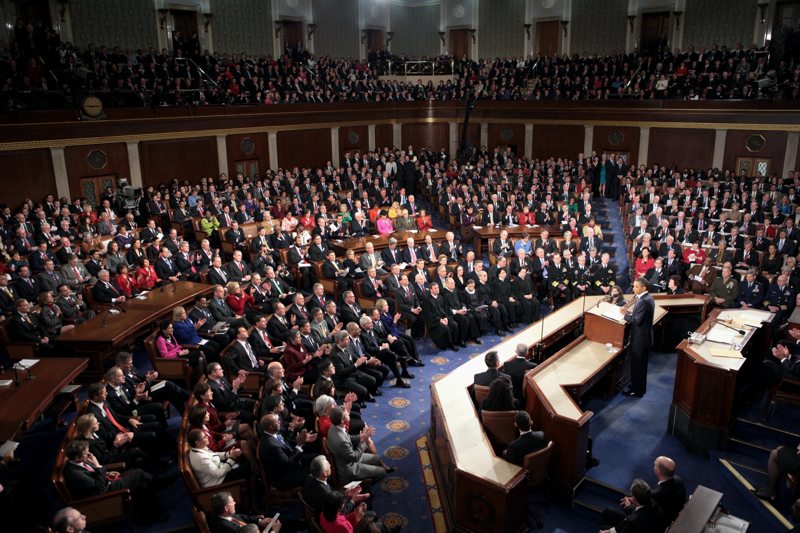
The speech is given in the chamber of the U.S. House of Representatives to both houses of Congress. All U.S. Senators and all members of the House of Representatives sit “on the floor” of the House chamber (in chairs, but within the chamber itself, not the balcony above). Members of the President’s cabinet and members of the Supreme Court also sit on the floor. Invited guests fill the observation balconies above the floor.
They don’t just sit. TV cameras catch their reactions as the president speaks. Usually, he begins with a review of national values; then he looks at the problems he sees in reaching national goals based on these values; finally, he proposes his policies to resolve the problems and fulfill the goals. While overall, civility is maintained, in recent years there have been protests, and one faction or another may fail to applaud or otherwise show their disagreement with a presidential statement.
It should be noted that there are exceptions to the general rule that every player in government attends the speech. Traditionally, one cabinet member, and, since September 11, 2001, two designated members of Congress from each of the two major political parties, do not attend. This is in case a major disaster disables the rest of the government. Presumably, a new government would form from these survivors, allowing the nation to continue.
[You can find a glossary of some of the terms in this post at: http://quizlet.com/33769342/state-of-the-union-flash-cards/ ]
But President Obama’s January speech is more than a speech.
The United States Constitution is a short document. Its language is very economical. Yet it specifically states that the President “shall from time to time give to the Congress Information of the State of the Union, and recommend to their Consideration such Measures as he shall judge necessary and expedient.”
The first president, George Washington, translated “from time to time” into “each year.” His first Annual Message (as it was then called) was given in 1790 as a speech. Every year since then—almost 225 years—the President has submitted an annual report to Congress, although from 1801 until 1913, presidents gave an annual written report of national conditions, along with their policy recommendations, to the Congress.
Woodrow Wilson began the shift to a public oral speech in 1913. He thought a president could use the occasion to act as the nation’s spokesman.
The lesson wasn’t lost on those who came after him.
In 1923, President Calvin Coolidge used the new radio technology to share his policy proposals with the American people when he reported to Congress. President Franklin Roosevelt ushered the annual speech into its modern age: he was the first to popularize it as the “State of the Union” address.
It was first televised in 1947. Lyndon Johnson made the speech prime time television in 1965. A constitutional mandate to report to Congress is today a chance for a president to speak directly to the American people about his vision of what the country is and should be—and how to achieve that vision.
Anyone curious about U.S. government can see many of its major players if they watch the State of the Union. Almost everyone who is anyone in U.S. politics is there.
The speech is given in the chamber of the U.S. House of Representatives to both houses of Congress. All U.S. Senators and all members of the House of Representatives sit “on the floor” of the House chamber (in chairs, but within the chamber itself, not the balcony above). Members of the President’s cabinet and members of the Supreme Court also sit on the floor. Invited guests fill the observation balconies above the floor.
It should be noted that there are exceptions to the general rule that every player in government attends the speech. Traditionally, one cabinet member, and, since September 11, 2001, two designated members of Congress from each of the two major political parties, do not attend. This is in case a major disaster disables the rest of the government. Presumably, a new government would form from these survivors, allowing the nation to continue.
[You can find a glossary of some of the terms in this post at: http://quizlet.com/33769342/state-of-the-union-flash-cards/ ]
Sunday, 12 January 2014
Martin Luther King Jr.: Beyond Racial Equality
On January 20, 2014, there will be a National Day of Service celebrated in the United States. Many work places and schools will be closed. All across the country, people will volunteer to serve their communities. They make soup to deliver to places where poor people receive free meals; they clean parks and paint school rooms. They collect coats for the poor against winter's cold. Kids as young as 5 years old make craft items to raise money for people who have no homes. Teenagers make posters and write letters in support of different social justice projects.
All of this is in memory of Martin Luther King Junior. He was an African American Baptist preacher. He is best known as a leader for racial equality in the United States. This short video tells some of that story:
http://www.youtube.com/watch?v=fPeJOdX5SsY
But for Martin Luther King Junior, equality was about more than race. He understood that everyone needs education and work. He saw poverty as both immoral and dangerous to a democratic, civil society. Above all, he insisted that every person deserved respect and that each of us has the right to be heard and to be treated with decency.
Inspired by Mahatma Gandhi, King organized non-violent public demonstrations to focus attention on his campaigns and to build support for the political reforms needed to make changes.
His last campaign is known as the Poor People's Campaign. It tried to unite blacks, other minorities, and poor whites in a movement to persuade the U.S. Congress to adopt an Economic Bill of Rights. A part of this campaign, in King's mind, was a strike by city sanitation workers in Memphis, Tennessee. He went to Memphis to give his backing to the strike on April 3, 1968. That night, he delivered a powerful speech, now called the "I've Been to the Mountaintop" speech. The next day, he was assassinated as he stood on the balcony of his modest motel in Memphis.
After King's death in 1968, the Economic Bill of Rights was forgotten amidst political turmoil surrounding the Vietnam War, the assassination of Robert Kennedy, and the presidential election. But the ideas King championed live on in his powerful speeches. They continue to inspire new movements worldwide for economic and social justice.
Martin Luther King Junior's speeches still have power. The most famous, the "I Have a Dream Speech," was given at a huge civil rights rally in Washington, D.C. in August of 1963. You can see the text and hear Dr. King give it at:
http://www.youtube.com/watch?v=gevdV4LvipQ
King's commitment to social justice for all people is at the root of the Martin Luther King Jr. Day of Service. He envisioned what he called "the Beloved Community." Citizens would build it by living according to the nation's principles and working together to solve social problems.
So on January 20, schools and banks will be closed in the U.S. But for many, it won't be a "day off." It will be a day of citizen action and service to others.
"What is needed is a realization that power without love is reckless and abusive, and love without power is sentimental and anemic. Power at its best is love implementing the demands of justice, and justice at its best is power correcting everything that stands against love."
Dr. Martin Luther King, Jr.
16 August 1967
Glossary: Some terms in the biographical video and in the above text can be found at
http://quizlet.com/33640924/mlk-national-day-of-service-flash-cards/alphabetical
All of this is in memory of Martin Luther King Junior. He was an African American Baptist preacher. He is best known as a leader for racial equality in the United States. This short video tells some of that story:
http://www.youtube.com/watch?v=fPeJOdX5SsY
But for Martin Luther King Junior, equality was about more than race. He understood that everyone needs education and work. He saw poverty as both immoral and dangerous to a democratic, civil society. Above all, he insisted that every person deserved respect and that each of us has the right to be heard and to be treated with decency.
Inspired by Mahatma Gandhi, King organized non-violent public demonstrations to focus attention on his campaigns and to build support for the political reforms needed to make changes.
His last campaign is known as the Poor People's Campaign. It tried to unite blacks, other minorities, and poor whites in a movement to persuade the U.S. Congress to adopt an Economic Bill of Rights. A part of this campaign, in King's mind, was a strike by city sanitation workers in Memphis, Tennessee. He went to Memphis to give his backing to the strike on April 3, 1968. That night, he delivered a powerful speech, now called the "I've Been to the Mountaintop" speech. The next day, he was assassinated as he stood on the balcony of his modest motel in Memphis.
After King's death in 1968, the Economic Bill of Rights was forgotten amidst political turmoil surrounding the Vietnam War, the assassination of Robert Kennedy, and the presidential election. But the ideas King championed live on in his powerful speeches. They continue to inspire new movements worldwide for economic and social justice.
Martin Luther King Junior's speeches still have power. The most famous, the "I Have a Dream Speech," was given at a huge civil rights rally in Washington, D.C. in August of 1963. You can see the text and hear Dr. King give it at:
http://www.youtube.com/watch?v=gevdV4LvipQ
King's commitment to social justice for all people is at the root of the Martin Luther King Jr. Day of Service. He envisioned what he called "the Beloved Community." Citizens would build it by living according to the nation's principles and working together to solve social problems.
So on January 20, schools and banks will be closed in the U.S. But for many, it won't be a "day off." It will be a day of citizen action and service to others.
"What is needed is a realization that power without love is reckless and abusive, and love without power is sentimental and anemic. Power at its best is love implementing the demands of justice, and justice at its best is power correcting everything that stands against love."
Dr. Martin Luther King, Jr.
16 August 1967
Glossary: Some terms in the biographical video and in the above text can be found at
http://quizlet.com/33640924/mlk-national-day-of-service-flash-cards/alphabetical
Subscribe to:
Posts (Atom)